
HEBREW WORD STUDY – TOWN COUNCIL – (ARAMAIC) – ‘EDATA’ עדתא
Matthew 18:15-17 “Moreover if thy brother shall trespass against thee, go and tell him his fault between thee and him alone: if he shall hear thee, thou hast gained thy brother. (16) But if he will not hear [thee, then] take with thee one or two more, that in the mouth of two or three witnesses every word may be established.(17) And if he shall neglect to hear them, tell [it] unto the church: but if he neglects to hear the church, let him be unto thee as a heathen man and a publican.”
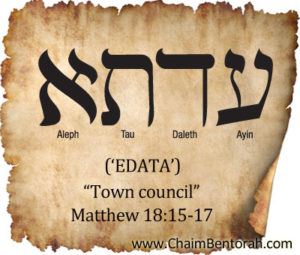 Many churches follow the direction that Jesus gave in handling disputes in the church in Matthew 18:15-17. However, there is one little issue, that proverbial elephant in the room. Practically every modern translation says church. Nobody seems to address the fact that the church did not exist at this time. The church only came into being after Jesus went to heaven. A couple translations will say the assembly or congregation. Actually, there were no congregations or Christian assemblies at this time either, just synagogues and local fellowships.
The Greek uses the word ekklesia or the called out ones. It comes from the root word kaleo which means to call. Ekklesia is where our English word church is derived but it does not necessarily mean church as we understand it today. The Aramaic word that Jesus used is edata from the root word eta which means a group of elders from the town. Every community had their own town councils who disputed civil and criminal cases, there was no real federal law other than the laws of Rome which would not that numerous. Most communities had their set of rules and regulations.
That is why Jesus said in Matthew 10:14 that if one town does not accept you, go on to another. Religious law was almost always mixed with civil law in Middle Eastern towns as it is today in most parts of the Middle East. As it is today in all religions including Christianity, there are many diverse beliefs. Christianity has many different denominations. Picture one town where everyone is a Baptist and another town where everyone is a Pentecostal. Now try to picture that the laws of that town revolved around Baptist doctrine and if you are a Pentecostal and started to pray in tongues, you could be forced to leave the town, or even arrested and thrown into a prison for breaking the law of that town.
So the apple is not too far from the tree to say that if there is a dispute within the church then to call the elders of the town or community together would be like calling the elders of the church together. But back to this word edata. The first-century mind when hearing the word edata would picture a group of elders in a town who would select from among themselves leaders to govern the town. These were always men of advanced age as Oriental culture considered men of advanced age to be wise. For one thing, just making it to an advanced age in those days took a lot of wisdom. Anyways, the elders would select from among themselves individuals to serve on a cabinet so to speak with a chief elder ruling. Sort of like our supreme court. They would sit in judgment and pronounce sentences according to the rules and religious beliefs of their community. So if you are in danger of being arrested it was best to flee to another town, where often you would be given protection. Offenses and crimes in one town could not be held against a person in another town. In fact, thieves often shared their spoils with the officials in another town.
In a way, our churches and denominations are carryovers to this system. If you commit some doctrinal offense in a church you could be brought before the hierarchy of that church but before that happens what will usually take place is the offender will flee to another church where he will be welcomed and his doctrinal discretion would not be a matter of concern to the new congregation.
I can’t help but think that maybe this is what Jesus had in mind in Matthew 18:15-17. He was sort of making a reference to Matthew 10:14: “And whosoever shall not receive you, nor hear your words, when ye depart out of that house or city, shake off the dust of your feet.” There are a couple schools of thought about this shaking the dust from your feet. The Jews thought that the dust of the Gentiles was impure and you needed to shake off the impurities. Another thought is that people believed that among holy men their wisdom and knowledge flowed out of their bodies through their feet and onto the dust. Thus the idea of leaving the town is not so much as saying: “There take that, done with you.” But Jesus was teaching them to leave some of their wisdom and knowledge about the kingdom of God before they leave.
I believe Jesus was teaching that if someone trespasses against the laws of your community, at least hear him out, give him a chance to explain his doctrinal difference and if it cannot be resolved then let him leave.


Recent Comments