
HEBREW WORD STUDY – REASON WITH GOD – YEHOKECH ‘EL הוכחnn אל
Job 13:3: “Surely I would speak to the Almighty and I desire to reason with God.”
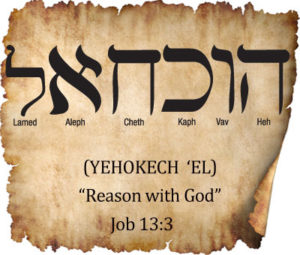 I really can’t blame Job for wanting to reason with God. After all, God can be so unreasonable at times. I would like to just sit down with Him and explain my circumstances. Surely once I explain everything He will come around, see the error of His way and reverse the situation I find myself in.
Poor Job is being afflicted by the opinions of his friends and their reasoning as to why he is suffering. If he is going to reason with someone it might as well be with God. Why not go to the source. Perhaps he can take this up with God and convince Him to reverse his circumstances.
The issue I have here, of course, is the word reason. Modern Translations are split down the middle as to using the word reason or argue. Can we really go to God, reason with Him or argue with Him and persuade Him to change His mind? No doubt our intercessory prayers will change God’s direction, but that is a matter of submitting our wills to Him. I mean really, does it help to build a case to support our position?
The Hebrew word for reason is something different. This word is yehokech which according to our Christian lexicons means to argue, plead, contend or reason; all with the purpose of showing how someone is wrong in their thinking and should change their mind. Can we really argue with God and show Him that He is being unreasonable or that He has not completely thought out a matter? Will God eventually say; “Oy, Chaim, you make a good case, when you’re right your right. I don’t know how I missed that point, I apologize, my bad.”
When it came to lexicographers finding an English word to use for yakach they “didn’t know what to call it so they called it” argue, reason or plead. But, as you already guessed, I found that ancient rabbis and sages go beyond our Christian lexicographers and take a different approach to define this Hebrew word. Believe it or not Jewish rabbis do not always depend upon a lexicographer’s opinion, often they will look deep into the context, tradition, historical and cultural considerations. Of course, no one better to understand Jewish culture than a Jewish rabbi or sage. For one thing, yakach is spelled Yod, Kaf, Cheth. The Yod represents a clarification of God’s priorities, the Kaf shows the development of a strong kavanah ie., the direction of the heart and the Cheth pictures the listening for the still small voice of God. In other words what I read in Jewish literature is that the word yakach in its Semitic root means to give clarity. Thus this arguing or reasoning does not have the end purpose of changing one’s mind but to provide clarity.
This afternoon my study partner was confused as was I to the request our publisher made with regard to our website. We tried to comply but we are both not very tech savvy. So, I discussed the matter with our publisher through emails. It might have appeared I was arguing or trying to reason with but in fact, I was just trying to understand. If I was seeking a change in anything it was in his explanation. Finally, he explained it in a way that I still did not understand the mechanics but I knew how to accomplish the task.
This is what Job was doing. He wasn’t trying to change what God did in his life, he just wanted to understand it. If the disaster of his life was God’s will then so be it, but he did want an understanding.
Yet, as we read this story of Job, it was not even right to ask God for an explanation for the simple reason he would never understand the explanation. Just as I would never understand the mechanics of what I was doing with the computer, I just had to have the faith that those who did the coding, something I just can’t begin to understand, knew what they were doing even though it made no logical sense to me. To spend time trying to figure it out would be like me spending time trying to figure out the logic in the coding. I would just waste a lot of valuable time and even if I did understand it, what difference would it make?
Something interesting, the pronoun I or ’ani in Hebrew does not have to be a pronoun, it could be a noun and thus its root word would be anah which means to moan, suffer or have sorrow. Hence we could render this verse as “Surely, my sufferings will speak to the Almighty and my desire is to know God’s purpose so my heart will follow the right direction and hear God’s still small voice.”
Job’s sufferings appealed to God, not to be delivered from the suffering but to understand it and submit to the Divine purpose and priorities of God. To Job, God’s purpose and priorities were more important to him than his own gizzard. The first thing our sufferings want to do is to appeal to God, which is fine, so long as that appeal is to know God’s purpose and priorities. Be aware, Job never did learn God’s purpose.
Some people say I am a smart man, that I can figure things out. But you want to know the truth? There are a lot of things I cannot figure out. There are many things I will never figure out. I have no doubt Job did in heaven what I will one day do in heaven. Sit on a bench at some street corner with Jesus and have Him it explain it all to me.


Rabbi, I’m so grateful for this insight. It would be precious for students of the bible to take an approach of the sages. That is to go beyond what is literally written and search culturally, historically or etc. Many blessings!
That certainly puts a different aspect on the passage. You are right in what you say in that you may not know or understand how things work but by faith you just do it believing in following the instructions the process works out. Me thinks it amazing!!
Thank you! I needed this!
Rabbi,
I believed that Job did not know God as he thought he did. I felt like he carried pride in his heart and through the trials he went through, then came humility on his part. I order for him to understand and know God, he needed to be broken. Whatever sins he had, they needed to be revealed to him and only God can do that.
I base it on theses scriptures. What do you think? Job.42
[1] Then Job answered the LORD, and said,
[2] I know that thou canst do every thing, and that no thought can be withholden from thee.
[3] Who is he that hideth counsel without knowledge? therefore have I uttered that I understood not; things too wonderful for me, which I knew not.
[4] Hear, I beseech thee, and I will speak: I will demand of thee, and declare thou unto me.
[5] I have heard of thee by the hearing of the ear: but now mine eye seeth thee.
[6] Wherefore I abhor myself, and repent in dust and ashes.
Apocolypse (revelation) was given to him by our God.
Chaim, you found in Job precisely what Paul relates in II Cor 12:7-10! “…A THORN WAS GIVEN ME in the flesh… three times I BESOUGHT THE LORD about this… but HE SAID TO ME…” It would appear that the Lord did not give answer to Paul in his first two seekings, but then related to him a much deeper explanation at a later third time when Paul could express contentment in hardships, for “then I am strong.” He was “not to be delivered from the suffering but to understand it and submit to the Divine purpose” of it. May we all learn that His voice can relate to us also deeper understandings which can bring us His peace and deeper purpose!
Abraham appealed to God several times regarding Sodom and Gomorah. God changed his mind for Abraham sake and because I believe he did not want to destroy them. Suppose Abraham had kept pleading till he got to just one who loved God? Maybe Sodom and Gomorah would still have a chance to repent even today. No man knows the mind of God but we have been given the mind of Christ and through Christ we know the Father does not want anyone to go to hell. I personally believe if there are prayers we can pray through the Holy Spirit there really is a chance God will change his mind and do anything to save people. Things we cannot imagine or can we imagine and hope and believe. Even to resurrecting Lazuras to tell the brothers of a rich man in hell that if they dont repent they to were headed for hell. Just something I believe may have happened. GODS ARM IS NOT SHORT! AMEN TO GOD THE FATHER IN CHRIST NAME. Be blessed today my brother and Glory to God. I know thse are different stories but still maybe not.