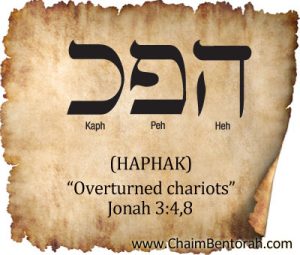
HEBREW WORD STUDY – OVERTURNED CHARIOTS – HAPHAK הפכ
Jonah 3:4,8: “And Jonah began to enter into the city a day’s journey, and he cried, and said, Yet forty days, and Nineveh shall be overthrown. (8)But let man and beast be covered with sackcloth, and cry mightily unto God; yea let them turn everyone from their evil way, and from the violence that is in their hands.”
 I am tempted to write a book on the story of Nineveh during the time of Jonah but I fear I would be too sided tracked with comparing the City of Nineveh in 800 BC to a modern Hermit nation that is giving our nation a lot of headaches. My ministry partner has done an interesting study on Isaiah 46:10 which basically teaches that we can know the future by looking at the past and the more I study the history of Assyrian Empire and their capital city Nineveh, the more I see parallels to this little nation today that is giving us such concern. I shared a little of this on our Full Access but I just sense God holding me back from actually writing a book on this and its parallel to today’s news.
What I find particularly interesting is that all 120,000 residents of this city repented when this reluctant prophet and evangelist declared to the city that if they did not repent they would be overturned which in the Hebrew is the word – haphak. It did not say destroyed charam but just overturned. Why just overturned, why not destroyed, why not use the word charam which means total annihilation. Just simply overturned would not strike that much fear, after all, rulers were being replaced all the time. Actually, the word haphak would have struck at the very heart of the Assyrian Empire. The Assyrians spoke the Akkadian language and in the Akkadian the word haphak means an overturned chariot.
Now let’s go back in history, what was the most fearsome weapon during 800 BC? It was the development of the chariot. The chariot gave warriors mobility and speed. It was the nuclear weapon of its day. Both Assyria and the Babylonians were feverishly developing the chariot just like we are developing nuclear weapons today. The Assyrians had the edge over the Babylonians as they would spend 20 years breeding the horses necessary to pull their chariots. They trained young teenager not only in the skills to be a charioteer but also to develop their muscular strength so after years of training they could handle the horses that pulled the chariots. The Assyrians were the best in the world, just like the United States has the best nuclear capabilities in the world. Yet, for the city of 120,000 people in Nineveh, they were in constant fear of an invading army of chariots that could somehow penetrate their defenses and enter their city. Everyone knew and understood the terror that would result if an army of chariots were to break through the defenses of Nineveh and enter the city. They did not only fear the Babylonians but the little rogue nations like Israel as well. Their intelligence was not as elaborate as it is today and there were always rumors that some enemy had developed chariots more powerful than theirs and these little nations were always considered a threat of making the first strike. They knew Israel and knew Israel feared an attack by the Assyrians and thus if Israel had the capability they would initiate a first strike. They were considered crazy enough to do it.
The Hebrews were not so much a feared nation as they were an unpredictable nation. Other nations you could pretty well predict what they would do, but not the Hebrews they were resourceful and cunning. They could develop chariots far superior to the Assyrians and were known for their shrewd military tactics, as they are today. Thus, the most powerful city in the world, capital of the most powerful nation in the world was terrified by a little rogue nation like Israel.
When a representative of that little nation appeared in the city declaring that in 40 days if they do not repent to God Jehovah, they would experience a haphak an overturn of their chariots. Legends were rampant how the God of Israel delivered the Hebrews in the past, they knew the history of Israel and how powerful their God was. Nineveh worshipped the god Dagon, which was the fish god. Three days in the belly of a fish would have turned Jonah into a hideous sight with his hair burned away from the stomach acids of the fish and his skin bleached out by the fish’s digestive juices. For Jonah to explain to those who asked what happened to him he would say he was swallowed by a fish and God Jehovah delivered him. God overcame their god Dagon. That would have convinced the people that the Hebrews were about to attack not only with their chariots outclassing theirs but with the power of the Hebrew God behind them.
The point of this story is that revival came to Nineveh because of the message of the haphak overturning of their chariots by the God of Israel. You know, I have learned that when I wander too far away from God, God will send some messenger, human or just a sign from His creation to remind me that under His control my best defense can easily haphak, be overturned. Your haphak could be a job, a money management account, a relationship. What would happen if God sent you a message that your haphak was going to be overturned in 40 days unless you repented? I think most of us would find some sackcloth and ashes. The Book of Jonah reminds us that God is not above haphak(ing) the arm of the flesh that we depend upon more than Him.



Repent or God will attack your strongest weapon and render it useless.
Wow, Be there, But as the Word says. He corrects, But Binds up and heals and restores. Turn to your stronghold and I declare this day I will render double to you. Zach 9:12 .