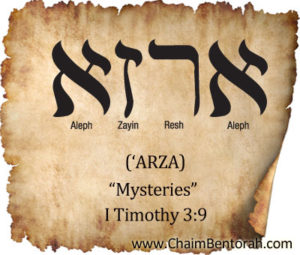
ARAMAIC WORD STUDY – MYSTERIES – ‘ARZA ארזא Aleph Resh Zayin Aleph
I Timothy 3:9: “Holding the mysteries of the faith in pure conscience.”
 It seems like every Bible student, pastor and teacher has chimed in on this verse with their idea of what the Apostle Paul was talking about when he speaks of the “mysteries” of the faith. Many never stop to consider the word “mystery” and automatically think in terms of, you know – Agitha Christie. A Bible student will look at this word in the Greek and find the word “musthrion” which has the idea of “close kept” or “secret.” A Bible College or Seminary professor will check the Septuagint and discover that “musthrion” is used for the Hebrew word “sod” which means secret.
There is a little known fact. The Jews in the first century were forbidden to learn a pagan language like Greek. Although Paul would have had some knowledge of Greek to get around, he would not have really been fluent enough to write I Timothy in such beautiful Greek, it was most likely transcribed by a scribe. Paul’s native language is Aramaic and Aramaic is very difficult to translate into another language that is not Semitic which the Greek is not. The Aramaic word used here for mysteries is ‘arza. This is the Aramaic word for a cedar tree. A cedar tree was noted for its firm roots which ran deep. Thus ‘araza has the idea of deepness and firmness. In Aramaic it is an idiom for a scholar or philosopher. So Aramaic is still barking up the same tree as the Greek but it is really a reference to a scholar in Eastern thinking and not Western thinking. In Western thinking when we hear the word scholar we associate it with someone who is well read, well traveled and can quote many teachers. However, the Eastern, Semitic scholar is one who has studied on his own and teachers only serve as inspiration to direct his thoughts. A Jewish scholar could be one who never attended a university but spent many hours studying Torah on his own and with a study partner to discuss the many mysteries that God reveals to Him. In our Western culture and church we believe the mysteries of God have already been revealed and we sit under the teaching of those who have that revelation or has studied the ones who had that revelation. We learn someone elses revelation and never stop to get our own.
You want to know what I think? Fine, I have a free website you can read. But if you want to know what God is teaching you personally that may be different from my thoughts, we have an All Access subscription site where you can learn Hebrew and Aramaic, where we teach you to study the Word of God in the original languages so you can learn what God, the Holy Spirit is teaching you not what Chaim Bentorah is teaching.
You see a mystery is an attempt to define ambiguities. I once asked an orthodox rabbi to teach me the mysteries of God and he replied: “I can’t teach you, you must learn yourself.” In Christianity, and I find particularly in the Western prophetic movement, we have a tendency to go from fad to fad. God moves and reveals Himself in a certain way though a certain expression of worship. It is really effective, wonderful, you feel the presence of God, you experience the miraculous, but before long you start to grow bored with that form of worship. The spontaneity wanes and in desperation the leaders begin to program this worship, write out a script to follow. The faithful doggedly stay with the script hoping to recapture that glow they once felt. Along comes some new prophet with some new revelation on worship and prayer and then people are flocking to him, getting all excited, feeling like they are on the cutting edge. Before long that wears thin and the leaders panic and start scripting it out.
This is not what Paul was referring to. You see our faith is very fluid, we are always moving from glory to glory. For over 45 years I have studied the Word of God in Hebrew, Aramaic and Greek three to four hours a day and yet I am but a child in learning to worship and pray. That is why David often says: “My God,” He is no one else’s God, at least not in the way he is intimate with Him. See He is your God, Jesus is your personal Savior.”
We hold these mysteries of faith in pure conscience. Conscience is the word tirta which means to form an image in your mind. The word pure is dakia which means to be pure and cleansed as cleansed from sin. You see that is why you use your teachers, your pastors as only inspiration to study deeper on your own. How can you be sure any teacher, even Chaim Bentorah is sharing from a tirta dakia, a pure mind? What God reveals to you you will know if you are receiving it into a pure mind.


The mysteries of the faith were revealed to Paul and he shared them with us. The mysteries of our personal journey on earth with Christ are revealed to us alone and for the most part when I try to explain them to someone else well I may as well be speaking to the wall.
Very wise advice.
Thank you
Intriguing
Thank you so much! I have come to the knowledge by revelation that ‘salvation is personal’. I thank you because the things you have said bear witness with my spirit which is the purest conscience because of its oneness with Jesus. Shalom!
Selah
I thank God for you, for what you have written above has helped me so much in ways I cannot express here, thank you, so very much.