
HEBREW WORD STUDY – DAYS OF CONTACT – YAMIM MIQEDEM ימים מקדם Yod Mem Yod Mem Qop Daleth Mem
Psalms 143:5-6: “I remember the days of old; I meditate on all thy works; I muse on the work of thy hands. (6) I stretch forth my hands unto thee: my soul [thirsteth] after thee, as a thirsty land. Selah.”
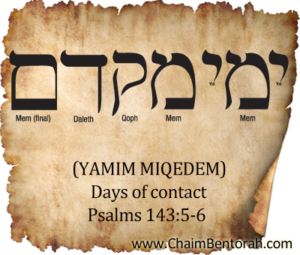 The title that is given for Psalms 143 in the Septuagint and other historical books suggest that this Psalm was written as David was fleeing from his son Absalom who staged a coup with David’s best friend causing him to flee from the throne with just a few loyal followers and a price on his head. This had to be the worst time of his life. Losing his kingdom through the betrayal of his own beloved son and his best friend.
It is during such a time that one often reflects on the past glories and what once was. At night David would likely sit around with his followers and regale them with stories of the past. He would tell of is battle against Goliath, his fleeing from King Saul. He might even have shared stories of his boyhood and how he had slain a lion with his bare hands. Such stories would likely encourage his followers and himself that the glory days were not over, that he would reclaim the throne and overcome his enemies as he did countless times in the past.
But in his quiet moments, alone with God, his reflections were on something entirely different. He remembered the days of old but it was not reflecting on how he killed a lion, Goliath or escaped from the hand of King Saul. No, what he reflected on was how he meditated on all the works of God. The word meditate is hagah in a simple Qal perfect form. It is a completed action. It is something he did in the past. Hagah has the idea of moaning, groaning, deeply pondering.
I have met a number of people who proudly tell me that they are on track to read the entire Bible through in one year. They have this little guide that if they read a certain amount of verses each day for ten minutes, they will read through the entire Bible. Actually, at a normal reading speed, you could read through the Bible in 70 hours. According to Nielsen ratings the average person watches 35.5 hours of television a week. So, if you sacrificed television for two weeks, you could read through the whole Bible in two weeks, not one year. I am not impressed. Even if you read through the Bible in two weeks I would still not be impressed. I study the Word of God at least 35.5 hours a week and usually more. Ok, I write daily devotionals, I write books on translation of the Bible, I do a daily FaceBook teaching as well as teach a Midweek Bible Study, A Weekly Torah Portion Study, and a Weekly translation workshop, as well as write a weekly In-Depth Study. You are looking at 50-60 hours a week in study and I would likely spend more time to get all this done but I do work a 40 hour a week job.
However, as I read of the life of David, I realize my 50-60 hours a week of study and preparation is not impressive. David meditated on God’s works or poal in Hebrew. Poal is the result of one’s creation. You can create a work of art and poal is the resulting appreciation that creation brings. To meditate on the works of God is to appreciate the creations of God including his Torah. But note David did not read the Torah or reflect on God’s creation. He did not study the Torah or God’s creation, he meditated on it. The word meditate in Hebrew is hagah which means to moan or groan in deep contemplation and pondering. You can read God’s word, you can study God’s word like I do but do we really meditate on God’s word? Do we moan, groan and agonize over God’s Word and His creation seeking to discover a clue to our relationship with Him.
I started myself to do some reflecting on the days of old. Those words days of old in the Hebrew shook me up, I mean really shook me up. The word days is yamim which means days, events or times. The word old is what haunts me, it is the word qadam. Yes, it means something preceding but it also means to make contact. There is a double meaning here, a play on the word qadam. David was meditating deeply pondering, becoming one with the days of contact hoping to recapture that special contact. He considered those days when he meditated on the Torah day and night, those days as a shepherd boy when he would look up at the night sky and see the stars and just meditated on God and His greatness.
I believe David was reflecting on those days of long ago when he made contact with God in a special way and was longing for those times again. I am sure He reflected on the possibility that God allowed him to suffer this great heartbreak from betrayal and loss of his kingdom to bring him back to those days when he qadam made contact with God in that special way through His meditation on Torah and His creation.
Lately, I find myself going through a very difficult time. I called on God asking why I had to go through this. He led me to Psalms 143 and I realize that I was just reading God’s word and studying it for preparation but I was no longer meditating on it nor meditating on God’s creation and I was losing, like David, that special contact.
I can hear that call to silence that I heard many years ago. By the grace of God, I will return to a time of silence not to read or study but to meditate. How about you, do you hear that call return to the days of old or those days of a special contact? Is God calling you to not read or study but to meditate?


Thanks for this message. I’ve been struggling lately with the word meditate. I am embarrassed to say, I’m not certain exactly how to meditate. I know it’s been likened to a cow chewing on her cud, bring it back over and over again to get every bit of nutrient out of it. But I am still at a loss. Would you be able to shed more light on how one actually goes about the process of meditation?